

Pilgrimage Reflections #2
Buddha Was Born in Nepal
To sit in meditation in Lumbini at the Sacred Garden, is to be aware—quietly but unmistakably—that this is the place associated with the birth of the Gautama Buddha.
That awareness does not need to be emphasised.
It is already present in the atmosphere.
A Shared Stillness
I was not alone.
There were hundreds of people moving through the garden—some in groups, seated together while a monk led chanting; others walking slowly, or sitting quietly with family members.
Despite the numbers, there was no sense of crowding.
What stood out was a shared intention:
not to observe, but to participate.

Around the Mayadevi Temple
Babita and I walked around the Maya Devi Temple, pausing at different points without any clear plan.
Chanting could be heard nearby—steady, rhythmic, unforced.
At times we stopped to listen.
At other times, we simply continued walking.
Eventually, I sat beneath a pipal tree.
Sitting with the Three Marks
There, the focus settled on a teaching that has gradually become central to my own practice:
the three marks of existence.
Not as something to analyse, but something to observe:
- change
- unsatisfactoriness
- the absence of a fixed self
Sitting in that place, attention moved naturally toward these reflections.
There was no need to direct it strongly.
Presence Not Explanation
What stood out most was not the setting itself, but the quality of experience.
There was a sense of stillness, even with movement all around.
At times, a noticeable energy in the body—difficult to describe, but clearly felt.
Not something to interpret.
Simply something that arose, and passed.
The Beginning of Five Days
This was the first day of a five-day stay in Lumbini, part of a wider Nepal pilgrimage.
Each day followed a similar rhythm:
time in the Sacred Garden, followed by visits to different temples within the Peace Park.
But not as a series of sights to see.
More as a gradual process of observation.
Temples from Many Traditions
Across the Peace Park, temples from different countries stand side by side—Sri Lanka, Japan, Korea, Myanmar, China, Tibet, Nepal.
Each carries its own architectural style and atmosphere.
Inside, the spaces are often striking:
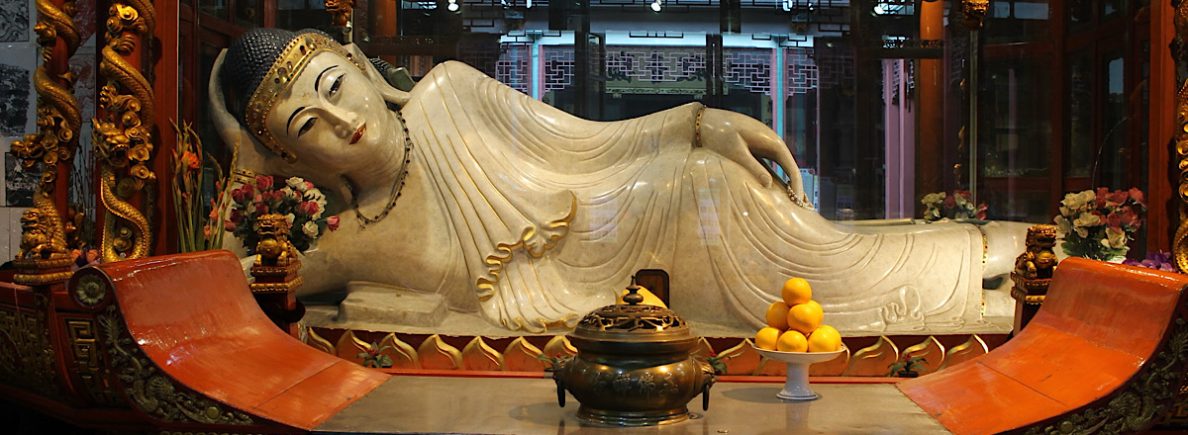
golden Buddha images, colour throughout, carefully constructed detail.
And yet, what remains consistent is the same underlying quality:
a sense of quiet, and of attention.
Looking More Closely
These temples will be explored more fully in later reflections.
Not from the perspective of architecture or travel, but from what becomes apparent when spending time within them.
For now, what remains is the simplicity of that first day:
walking, sitting, listening.
And noticing what is already present.
Continue Reading
This reflection builds on an earlier experience in the Nepal pilgrimage of bringing temple practice into everyday life:
Fabulous post – I love how you mention that interpretation was not necessary… I too have found that much of my recent wisdom gained through mindfulness rarely arrives while thinking. Thank you for sharing this experience! Linda xx
Hi and thank you so much for commenting on my post. I really must apologise for the delay but you had disappeared into my spam folder. 🙏 Please don’t be put off making future comments …… all should be fine now 🙏